Jennifer Carter
VP of Community Management, CMCA®, Robson Property Management
One situation we regularly see with HOA boards around Tulsa and Broken Arrow, Owasso, Bixby, and Jenks looks something like this: a major pool repair comes up, reserves are thin, and homeowners suddenly face a special assessment nobody was expecting.
It usually isn't because the board didn't care or wasn't trying to manage the community responsibly. More often, the budget was built the way many association budgets are built, by taking last year's numbers, increasing a few categories, and hoping there aren't any major surprises.
After more than 30 years of working with communities and association boards, we've seen how quickly that approach can create problems.
A community association budget isn't just a spreadsheet the board approves once a year. It's the financial plan that determines whether your neighborhood can pay its regular bills, maintain common areas, prepare for major repairs, and keep assessments as predictable as possible for homeowners.
Here's what HOA and community association boards in Oklahoma, Arkansas, and Missouri should consider when planning their next budget.
What Should an HOA Budget Include?
Most community association budgets have two primary components: the operating budget and reserve funding.
The operating budget covers the recurring expenses needed to keep the community running. Depending on the association, that may include:
Operating Budget
- Landscaping
- Utilities
- Insurance
- Community management fees
- Pool maintenance
- Common-area maintenance
- Administrative expenses
- Vendor contracts
- Routine repairs
Reserve Fund
- Roof replacement
- Private road or parking lot resurfacing
- Pool resurfacing
- Clubhouse repairs
- Exterior painting
- Fencing
- Irrigation system replacement
- Major equipment replacement
Boards can run into trouble when operating expenses and long-term capital needs aren't planned separately.
If money intended for future repairs continually gets used to cover today's operating expenses, the association may have few options left when a major component eventually needs replacement.
How to Build an HOA Budget
A strong HOA budget usually shouldn't begin with a blank spreadsheet a few weeks before the new fiscal year.
The boards that tend to have the smoothest budget seasons start earlier and review what has actually happened financially before deciding what should happen next.
At Robson Property Management, we encourage boards to review several years of historical expenses whenever possible rather than relying only on the previous year's budget.
A thoughtful HOA budget planning process may include:
Review the Governing Documents
Before making budget decisions, the board should review the association's declaration, bylaws, policies, and other governing documents. These documents may contain requirements related to budgeting, assessment increases, homeowner notices, reserve funds, or approval procedures.
Compare Budgeted Expenses to Actual Expenses
A budget can look balanced on paper while actual spending tells a very different story. Boards should compare what was budgeted against what was actually spent in each major category and look for patterns. If landscaping has exceeded budget for three consecutive years, for example, simply copying the old landscaping number into next year's budget probably isn't realistic.
Request Updated Vendor Pricing
Vendor pricing can change significantly from one year to the next. Instead of assuming the association's current landscaping, maintenance, insurance, or service costs will remain the same, boards should collect updated information before finalizing the budget. Strong vendor compliance practices, verifying insurance, licensing, and contract terms, also help protect the association financially and operationally.
Account for Rising Costs
Utility rates, insurance premiums, materials, labor, and contractor pricing rarely remain flat forever. In Oklahoma, Arkansas, and Missouri, weather-related maintenance and seasonal expenses can also create unexpected pressure on community budgets. One expense we frequently see underestimated is irrigation and landscaping. A relatively small irrigation problem combined with summer heat can quickly increase both water usage and maintenance expenses. Insurance is another category boards should review early rather than automatically carrying forward the previous year's premium.
Plan for Delinquent Assessments
A budget that assumes every homeowner will pay every assessment exactly on time may create an unrealistic financial picture. Associations should consider historical collection rates and work with their management and accounting professionals to determine whether an allowance for delinquent assessments or bad debt should be included.
HOA Reserve Fund Planning
Reserve planning is one of the most important, and most frequently overlooked, parts of community association budgeting.
A reserve study evaluates major common-area components and estimates:
- Their current condition
- Their remaining useful life
- Their estimated replacement or repair cost
- How much the association should be setting aside over time
Depending on the community, a reserve study may include roofs, roads, pools, sidewalks, siding, clubhouses, fencing, mechanical systems, or other shared assets.
Without that information, boards are often forced to guess.
And guessing can work for several years, right up until a major repair is needed.
The appropriate reserve contribution is different for every association. A newer community with few major shared components may have very different needs than an older association with a pool, clubhouse, private streets, and aging infrastructure.
For that reason, boards should avoid relying on a single percentage as the answer for every community.
A reserve study provides a much better foundation for determining how much the association should contribute each year.
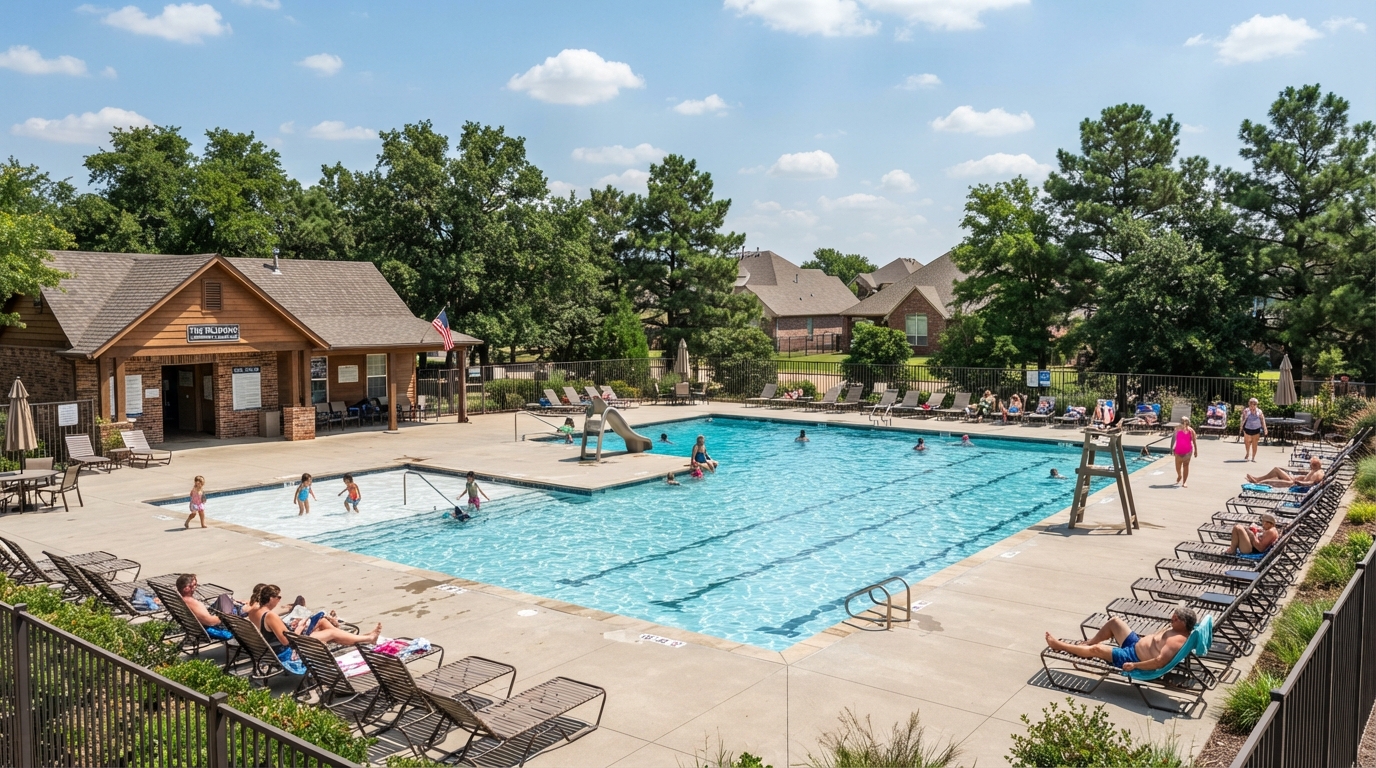
Reserve funds help cover major repairs to community amenities like pools, clubhouses, and roads.
HOA Budget and Reserve Requirements in Oklahoma, Arkansas & Missouri
Reserve and budgeting requirements can vary depending on the state, type of association, governing documents, and circumstances of the community.
Unlike states that have broad mandatory reserve-study or minimum reserve-funding requirements, Oklahoma, Arkansas, and Missouri generally leave a significant amount of reserve planning to the association's governing documents and board.
That makes thoughtful financial planning especially important.
Oklahoma HOA Budget Considerations
Oklahoma associations should review their governing documents carefully for provisions related to budgets, assessments, reserve accounts, notices, and board authority. Even when a specific reserve funding level isn't mandated, boards still have a responsibility to make financial decisions with the long-term interests of the association in mind.
Arkansas HOA Budget Considerations
Arkansas boards should likewise review their declaration, bylaws, and other governing documents when establishing assessment levels and planning for future repairs. A lack of a predetermined statewide reserve percentage doesn't mean an association can ignore long-term capital needs.
Missouri HOA Budget Considerations
Missouri condominium associations may be subject to provisions of the Missouri Uniform Condominium Act. For example, Missouri's condominium resale-certificate requirements include disclosure of anticipated capital expenditures, capital reserves, financial statements, and the association's current operating budget. Other types of Missouri community associations may operate under different statutes and governing documents. Because requirements can vary by association type and community, boards should consult the association's governing documents and legal counsel when questions arise regarding specific legal obligations.
This article is intended for general educational purposes and should not be considered legal or accounting advice. Association boards should consult qualified legal and financial professionals regarding their specific obligations.
Financial Reporting for HOA Boards
Creating the budget is only the beginning.
A budget becomes useful when the board regularly compares it against what is actually happening throughout the year.
Boards that review financial reports monthly or quarterly can identify problems while there is still time to respond.
If landscaping expenses are significantly over budget in March, the board has months to investigate the issue and make adjustments. If nobody reviews the variance until November, there may be very little flexibility left.
Regular financial reporting and management also gives boards better information when homeowners ask questions about assessments, expenses, or potential dues increases.
Instead of simply telling homeowners that costs increased, the board can explain where expenses changed and why.
That kind of transparency can turn a difficult financial conversation into a much more productive one.
5 HOA Budgeting Mistakes We See Across Tulsa, Northwest Arkansas & Missouri
Although every community is different, many of the same budgeting problems show up repeatedly.
Assuming Every Homeowner Will Pay on Time
Ignoring historical delinquencies can cause the association to overestimate the amount of cash it will actually have available.
Copying Last Year's Expenses
Vendor costs, utilities, insurance, and maintenance expenses change. Last year's budget should be a reference point, not the automatic starting point for every number.
Treating Reserve Contributions as Optional
When money gets tight, reserve contributions can be one of the first things boards want to reduce. Repeatedly doing that can create a much larger financial problem later.
Waiting Until Year-End to Review the Budget
Budget-to-actual reporting should happen throughout the year so boards can identify trends before they become major problems.
Increasing Assessments Without Explaining Why
Homeowners may not like assessment increases, but they are usually more receptive when the board clearly explains what's driving them. Insurance increases, vendor costs, aging infrastructure, reserve needs, and major projects should be communicated whenever appropriate. Otherwise, a financial decision can quickly become a trust issue.
Local Budgeting Challenges Can Vary by Community
Communities around Tulsa and Broken Arrow may face different maintenance priorities than associations in Northwest Arkansas or the Missouri Ozarks, but the budgeting fundamentals remain largely the same.
Weather, the age of the community, landscaping needs, private infrastructure, amenities, insurance costs, and vendor availability can all affect an association's expenses.
That's one reason a community's budget should reflect its actual property and operating history rather than a generic HOA budget template.
The budget for a neighborhood with a pool, clubhouse, private roads, gates, and extensive landscaping should look very different from the budget for an association responsible for only a handful of common areas.
How Robson Property Management Helps HOA Boards Build Better Budgets
Robson Property Management has worked with community associations and HOA boards for more than 30 years. We help boards throughout Oklahoma, Arkansas, and Missouri understand their expenses, review financial performance, plan for upcoming needs, communicate with vendors, and prepare realistic association budgets. Learn more about our HOA financial management services.
Our approach isn't simply to take last year's spreadsheet and increase every category.
We look at what the community has actually spent, what's changing, what major expenses may be coming, and what the board needs to know before making financial decisions.
That can include reviewing historical expenses, gathering updated vendor information, monitoring budget-to-actual performance, coordinating reserve planning, and helping boards communicate financial decisions more clearly to homeowners.
The goal is a budget that reflects the community as it actually operates, not the community everyone hopes it will cost to operate.
Insights from the RPM Team on HOA and community association management.
Frequently Asked Questions About HOA Budgets
How much should an HOA keep in reserves?
There is no single reserve balance or percentage that works for every association. The appropriate amount depends on the community's assets, their condition and remaining useful life, anticipated replacement costs, current reserve balance, and future capital projects. A professional reserve study can help a board determine a more realistic long-term funding plan.
Are HOA reserve studies required in Oklahoma?
Requirements can depend on the type of association, applicable law, and the community's governing documents. Oklahoma boards should review their declaration and bylaws and consult legal counsel when determining their specific reserve and budgeting obligations.
Are HOA reserve funds required in Arkansas?
Reserve requirements may vary depending on the association and its governing documents. Even when a specific reserve amount isn't mandated, boards should still plan for predictable long-term repair and replacement expenses.
What are the HOA reserve requirements in Missouri?
Missouri requirements can differ depending on whether the community is organized as a condominium association or another type of property owners association. Missouri condominium associations may be subject to provisions of the Missouri Uniform Condominium Act. Boards should review their governing documents and consult legal counsel regarding the requirements that apply to their specific community.
How often should an HOA review its budget?
Most associations adopt an annual operating budget, but boards should review budget-to-actual financial reports throughout the year. Monthly or quarterly reviews make it much easier to identify changing expenses and respond before small budget variances become larger problems.
What happens if an HOA doesn't have enough money in reserves?
An association with insufficient reserves may have to delay major repairs, increase regular assessments, borrow money, or impose a special assessment when an unexpected or major capital expense arises. Good reserve planning can't eliminate every unexpected expense, but it can make those expenses much easier for the association and its homeowners to manage.
What's the difference between an HOA operating budget and a reserve fund?
The operating budget generally covers recurring expenses such as landscaping, utilities, insurance, management, and routine maintenance. Reserve funds are typically intended for larger repair and replacement projects that occur less frequently, such as resurfacing a pool, replacing a roof, or repairing private roads.
Community Association Management in Oklahoma, Arkansas & Missouri
If your HOA or community association in Tulsa, Broken Arrow, or elsewhere in Oklahoma, Arkansas, or Missouri is preparing for budget season, Robson Property Management can help your board build a realistic operating budget, plan for reserves, review expenses, and prepare for upcoming community needs.
Request a ProposalAbout the Author
Jennifer Carter
VP of Community Management, CMCA®, Robson Property Management
Jennifer brings over 25 years of experience in Community Association and Property Management, with executive leadership experience since 2019. She holds a CMCA designation and is a licensed real estate broker, giving her a well-rounded perspective on both community operations and property values. She began her career as a Portfolio Manager and advanced through key roles in project management, training, business development, and corporate operations, giving her a comprehensive, ground-level understanding of every facet of association management.
Jennifer is known for building high-performing teams and scalable systems, with a strong focus on operational efficiency, sustainable growth, and leadership development. Central to her approach is the belief that exceptional client satisfaction and a positive client experience are foundational to long-term success. She is deeply committed to elevating service standards, improving communication, and ensuring that both boards and residents feel supported, informed, and confident in their management partnership.
Her experience spans developer-controlled communities, onsite and portfolio management, community transitions, business development, recruiting, training, customer service, corporate oversight, and capital improvement project management. By blending strategic oversight with a people-first mindset, Jennifer helps organizations operate more efficiently while delivering consistent, high-quality experiences for clients and the teams who serve them.
About Robson Property Management
Robson Property Management is a professional community association management company with more than 30 years of property management experience.
RPM's management professionals have experience with master associations, sub-associations, condominiums, townhomes, mixed-use properties, and communities with a wide variety of shared amenities and financial needs.
The company provides community association management, financial management, maintenance coordination, board support, governing-document administration, and related services, including property maintenance services, throughout Tulsa, Broken Arrow, Owasso, Bixby, Jenks, and the greater Oklahoma, Arkansas, and Missouri region.
Learn more about Robson Property Management and how our team helps community association boards operate stronger communities.
Sources & Editorial Standards
Robson Property Management creates educational resources to help HOA and community association board members better understand the operational and financial responsibilities involved in managing their communities. This article incorporates RPM's practical community-management experience along with publicly available statutory information. Laws and regulations can change, and association requirements may also be affected by governing documents and individual circumstances. For legal questions, boards should consult an attorney licensed in the applicable state. For tax, accounting, reserve-study, engineering, or other professional matters, associations should consult an appropriately qualified professional.